
Dilwara Jain Temples
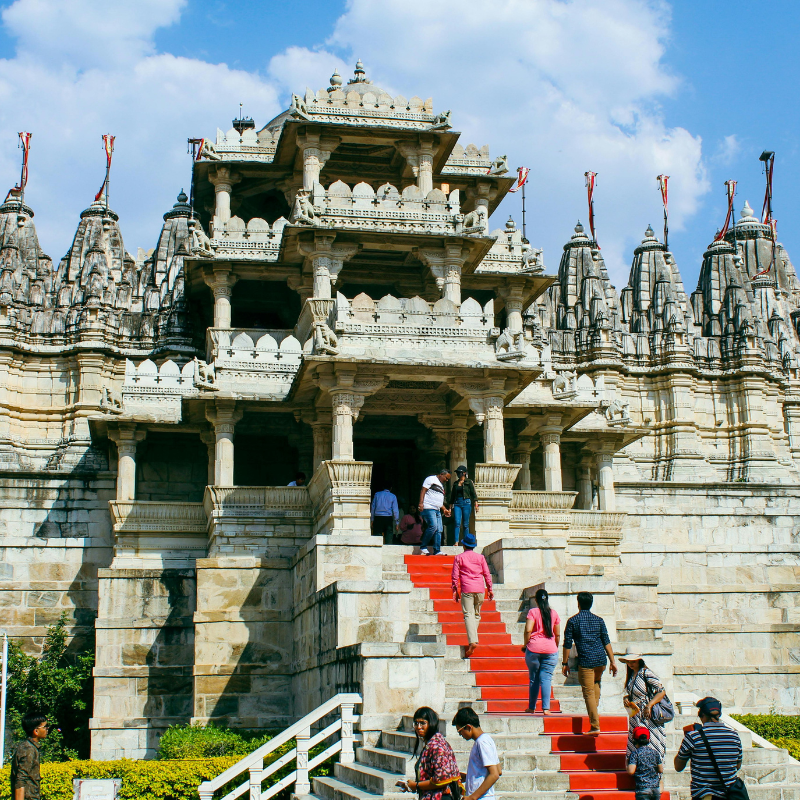
Dilwara Jain Temples:
Tucked away amidst the lush, forested hills of Mount Abu—Rajasthan’s only hill station—the Dilwara Jain Temples represent one of the absolute greatest architectural and stone-carving achievements in human history. Built between the 11th and 16th centuries during the reign of the Solanki dynasty, this complex consists of five legendary, interconnected temples constructed entirely out of luminous, pure white marble.
What makes Dilwara a global marvel is its extraordinary philosophy of hidden luxury. From the outside, the temples present a deliberately plain, modest stone facade designed historically to avoid attracting the attention of passing invaders. However, the moment you step across the threshold, the interior explodes into a jaw-dropping, lace-like maze of marble carvings so impossibly delicate that the stone appears completely translucent.
The architectural brilliance of Dilwara is heavily magnified when you consider the sheer physics of its construction. The pristine white marble used to carve these structures was not sourced locally; it was mined from the famous quarries of Makrana, located over 300 kilometers away.
Because Mount Abu rises to an altitude of over 1,200 meters, medieval engineers had to transport thousands of tons of massive marble blocks up steep, unpaved mountain cliffs without any modern machinery. Teams of hundreds of workers used massive lines of elephants to slowly drag the stone up the mountain ridges. To ensure absolute perfection, artisans were historically paid in gold dust equivalent to the exact weight of the marble shavings they carved away, encouraging them to create details as thin as silk thread.
The Five Architectural Masterpieces to Explore:
Vimal Vasahi Temple (Dedicated to Lord Rishabhdev): Built in 1031 AD by Vimal Shah, a minister of the Solanki ruler, this is the oldest and most opulently decorated temple in the complex. The absolute highlight is its central dome, which features a breathtaking circular ceiling adorned with 16 uniquely carved Vidyadevis (goddesses of knowledge) and hanging, lace-like marble pendants that defy gravity.
Luna Vasahi Temple (Dedicated to Lord Neminath): Built in 1230 AD by two wealthy merchant brothers, Vastupal and Tejpal, this structure rivals the Vimal Vasahi in pure artistry. The master artisans carved the central dome to resemble a lotus flower in full bloom, with marble petals carved so incredibly thin that light passes right through the stone.
Pithalhar Temple (Dedicated to Lord Adinath): This grand temple is famous for housing a massive, majestic idol of the first Jain Tirthankara cast out of five distinct metals (Panchadhatu), dominated heavily by solid brass.
Parshvanath Temple (Chaumukha Temple): Built in 1459 AD, this is the tallest, multi-story structure in the complex. It features a unique four-faced (Chaumukha) design, meaning the central grey-stone image of Lord Parshvanath can be viewed clearly from all four cardinal directions.
Mahavir Swami Temple: Constructed in 1582 AD, this is a relatively small, deeply intimate shrine dedicated to the final Jain Tirthankara, featuring exceptional wall paintings on its inner porches.
View Nearby Destinations
- All Events
- Destination


