
Bhangarh Fort
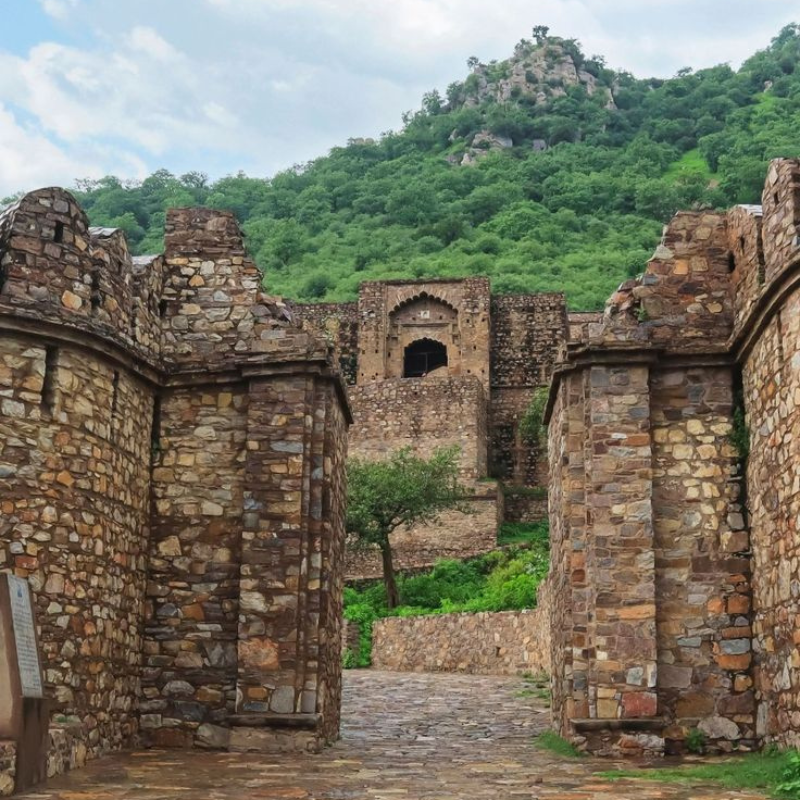
Bhangarh Fort:
Bordering the rugged expanses of the Sariska Tiger Reserve in the Alwar district of Rajasthan, Bhangarh Fort is an exceptionally well-preserved 17th-century fortified city. Built in 1573 AD by the Kachwaha Rajput ruler Raja Bhagwant Das for his younger son Madho Singh (brother of the legendary Mughal general Man Singh I), this extensive complex was once a prosperous urban hub featuring a multi-story royal palace, bustling market lanes, grand entry gates, and beautiful stone temples.
Today, Bhangarh is globally infamous as India’s most haunted location. Cloaked in chilling local lore and eerie ghost stories, the ruined city presents a fascinating juxtaposition: it is a stunning masterclass in medieval town planning that is legally abandoned to the wilderness the absolute moment the sun dips below the horizon.
The sudden, mysterious abandonment of Bhangarh by the early 18th century is explained by two dominant local legends, both involving absolute curses that allegedly doomed the city to ruin:
The Shadow of the Ascetic: The first legend states that Raja Ajab Singh (grandson of Madho Singh) sought to expand the fort. However, a revered ascetic named Guru Balu Nath, who meditated nearby, had permitted the fort’s construction on one strict condition: “The moment the shadow of your palaces touches my sanctuary, the city shall be no more.” Ambition overrode caution, and a higher column block cast a long shadow directly over the yogi’s retreat, causing the entire city to rapidly fall into ruin.
The Curse of the Dark Wizard: The more popular, romantic legend centers around Princess Ratnavati, the exceptionally beautiful daughter of Bhangarh. A wicked sorcerer named Singhia, deeply adept in black magic, fell in love with her. Knowing he could never marry her, he tried to enchant her hair oil with a love potion. Sensing the trick, the princess threw the vial against a massive boulder. The enchanted rock rolled over, crushing the sorcerer. Before drawing his final breath, Singhia cursed the town, declaring that everyone within the fort would perish and their souls would remain trapped inside the walls for eternity without rebirth.
Top Things to See & Do Inside:
Walk Through the Five Fortified Gates: The outer defensive grid is guarded by five monumental stone gates. Entering through the main Hanuman Gate reveals a sprawling historical layout. The pathway leads past the crumbling stone foundations of the Johari Bazar (the ancient market lanes) and residential quarters, where all houses conspicuously lack roofs.
Marvel at the Gopinath and Someshwar Temples: Curiously, while the residential sectors are entirely ruined, the complex’s grand Hindu temples remain beautifully intact. The Gopinath Temple, raised on a high stone plinth, features exceptional yellow stone carvings and elegant pillars that display classic Solanki structural styling.
Climb the Royal Palace Ruins: Positioned at the very back of the valley slope, the seven-story royal palace has now reduced to four atmospheric tiers. Stepping carefully through its vaulted dark stone corridors, broken archways, and sweeping stepwells offers a panoramic view over the entire valley.
See the Chhatri of the Sorcerer: Looking way up to the crest of the steep hill overlooking the palace, you can spot a small, solitary stone canopy (chhatri). Local guides point to this structure as the lookout point utilized by the legendary sorcerer to monitor the princess’s movements.
View Nearby Destinations
- All Events
- Destination


