
Chand Baori
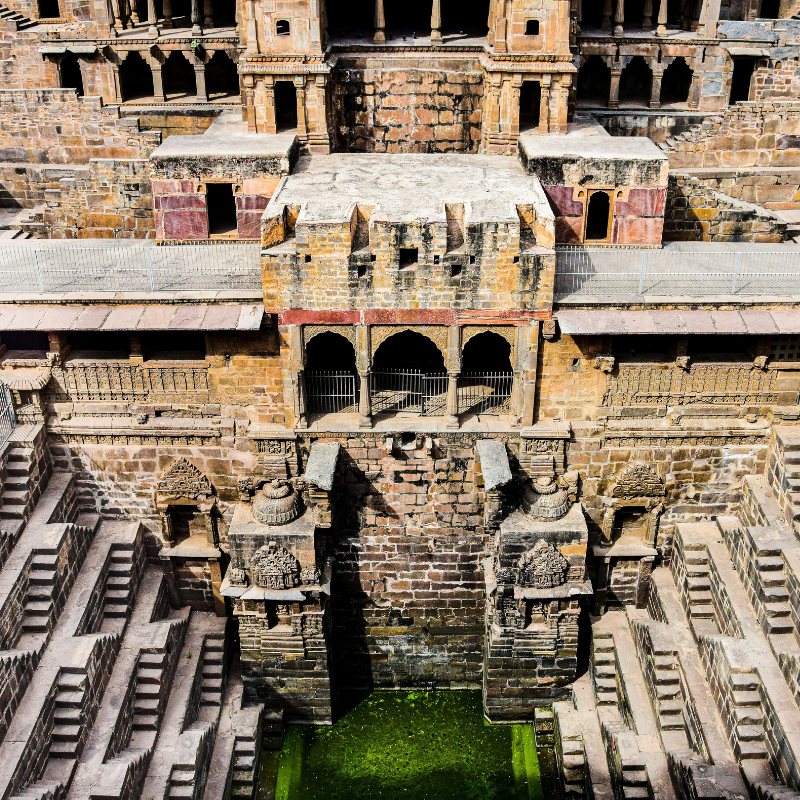
Chand Baori (Abhaneri):
Located in the quiet village of Abhaneri, roughly 95 kilometers east of Jaipur, Chand Baori is the oldest, deepest, and most architecturally jaw-dropping stepwell (baori) in India. Constructed in the 8th century AD by King Chanda of the Nikumbha dynasty, this massive subterranean structure is an absolute masterclass in ancient hydraulic engineering and structural geometry, plunging over 100 feet (30 meters) into the earth across 13 distinct tiers.
While palaces catch the sun above ground, Chand Baori turns architecture completely inward. It was designed not just as a monumental water reservoir to combat the intense, cyclical droughts of arid Rajasthan, but as a cool, breezy community sanctuary and a sacred prelude to the adjacent Harshat Mata Temple.
The Symphony of 3,500 Symmetric Steps
What makes Chand Baori a global artistic icon is its mesmerizing visual rhythm. Three of its internal walls are lined with a staggering maze of 3,500 narrow stone steps arranged in a flawless, hyper-symmetrical pattern. The steps look like an intricately woven stone textile or an optical illusion: as you look down from the rim, the triangular formations repeat infinitely toward the shimmering green water at the base.
The fourth wall of the stepwell breaks this pattern with a multi-story royal pavilion. This subterranean palace features grand pillared corridors, arched balconies, and two projecting chambers housing beautiful sculptures of the deities Mahishasuramardini (Durga) and Ganesha. The entire layout reflects a deep understanding of thermodynamics: down at the water’s edge, the air temperature naturally hovers a refreshing 5 to 6 degrees Celsius cooler than the scorching desert heat at the surface, allowing medieval royals to rest comfortably during peak summer.
Top Things to See & Do Inside:
Marvel at the Geometric Optical Illusion: Walk slowly along the secure upper viewing corridors to appreciate the mathematical precision of the 8th-century artisans. The layout was engineered so perfectly that every single step catches the light evenly, casting sharp geometric shadows that shift dramatically throughout the day.
Explore the Royal Pavilion and Carving Galleries: Peer into the multi-tiered royal galleries on the north face. The surrounding sheltered arcades serve as an open-air museum, housing hundreds of beautifully preserved, deeply carved stone panels recovered from the site, depicting mythological beasts, celestial dancers, and intricate floral patterns.
Visit the Adjacent Harshat Mata Temple: Located just a few steps away from the stepwell rim, this 8th-century temple is dedicated to Harshat Mata, the Goddess of Happiness and Joy. Though partially ruined during a 10th-century siege by Mahmud of Ghazni, its high stone plinth offers an incredible view over the village fields and features exceptional early medieval relief carvings.
View Nearby Destinations
- All Events
- Destination


